How to Create a Factory Video That Wins Export Buyers: A Guide from Digital Studio
If you are asking how to make a professional factory video for export buyers, the answer begins well before the camera is switched on.
Global procurement teams in the US, UK, Germany, and UAE commonly use supplier videos as an early screening tool alongside email and other communications
A factory walkthrough that looks like a smartphone recording shot between shifts tells a buyer everything they need to know: that your operations are not ready for scrutiny. Buyers often form a first impression within the opening seconds of viewing, and that impression is difficult to change.
Having documented industrial operations across India since 2008; I have seen firsthand what turns a plant walkthrough into a contract-winning sales tool. Here is a straightforward breakdown of how to plan, film, and deploy a factory video that passes global buyer audits. - Pashminu Mansukhani ↗ (CEO & Founder)
How Professional Factory Videos Win Global Export Contracts »
1. What Overseas Buyers Look For (The Mental Audit)?
Export buyers do not watch your video for entertainment; they are running a mental audit of your operations. They are evaluating four core questions:
Capacity: Can this plant handle my order volume?
Process Control: Is the manufacturing workflow organized and repeatable?
Quality Control: Where and how is quality verified on the floor?
Logistics: How does finished product leave the building?
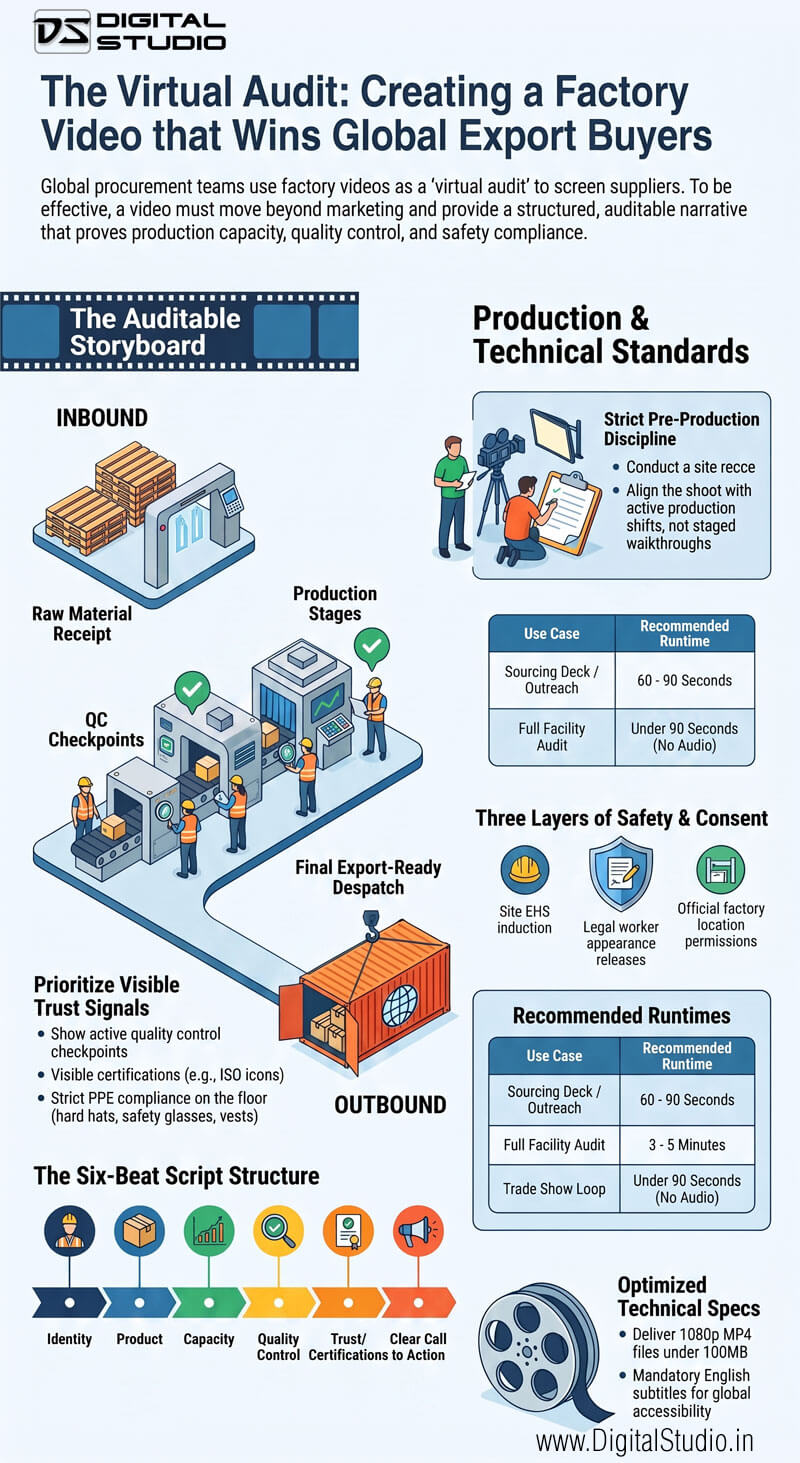
The most effective videos mirror a physical supplier audit by following a real order from incoming raw materials to final dispatch.
2. The 5 Trust Signals That Close Procurement Deals »
To pass a buyer's mental checklist, your video must highlight these specific proof points on camera:
Clear Certifications: Show physical certificates (such as ISO 9001, WHO-GMP, ISO 22000, or CE marks) on screen with their scope and issuing bodies clearly visible.
Active Quality Checkpoints: Show QC benches, gauges, and testing equipment in active use by operators.
Strict EHS & PPE Compliance: Ensure all floor personnel wear proper safety gear (helmets, gloves, safety shoes, eye protection).
Identified Personnel: Introduce key plant leaders and supervisors with on-screen titles showing their name and designation.
Export-Ready Packaging: Show proper palletizing, export labeling, and warehouse staging.
3. Pre-Production: Planning Before the Camera Rolls »
Most failed factory shoots suffer from poor preparation. Before bringing in a film crew, define one clear objective:
A 60–90 second RFQ response clip for quick email introductions.
A 3–5 minute complete facility tour for detailed buyer audits.
An OEM machinery demo focusing on equipment functionality.
Your Pre-Shoot Checklist:
Recce Visit: Map the plant layout, identify ideal camera angles, and note natural lighting windows.
Team Briefings: Inform supervisors and operators at least a week prior so shift routines are not disrupted.
Safety & Permits: Schedule site safety inductions, prepare visitor badges, and confirm PPE needs for the crew.
Consent Forms: Prepare worker consent forms under the Digital Personal Data Protection (DPDP) Act 2023 in languages workers understand.
4. The 6-Beat Script & Shot List »
A winning factory video follows a clear 6-part structure: Who you are → What you make → Production capacity → How you ensure quality → Why buyers can trust you → What to do next (Call to Action) .
The Core Shot Sequence (Film in Production Order):
Exterior Establishing Shot: Factory entrance, signage, and loading bays .
Management Intro: On-camera spokesperson (Director or Plant Head) .
Raw Material Intake: Receiving docks, racking, stock labeling, and material handling .
Active Production Line: Key processing and transformation stages in logical order .
Closing Screen with Contact Information: Company logo, website, direct contact details, and next steps .
5. Filming Safely Without Stopping the Line »
An experienced industrial video crew films alongside live production without creating safety hazards or shutting down machinery.
Factories Act Compliance: Crews must undergo site safety inductions, wear required PPE, and follow permit-to-work protocols in hazardous zones.
DPDP Act Compliance: Signed worker releases must be gathered for any identifiable plant personnel appearing on screen.
Zero Production Stoppage: Camera positions and lighting setups should be arranged during shift transitions or planned maintenance windows.
6. Technical Specs & The "3-Cut Strategy" »
A single shoot should generate three distinct video versions so you do not need to re-shoot for different marketing needs:
The Full Facility Audit (3–5 minutes): For deep procurement reviews and virtual plant tours.
The Outreach Clip (60–90 seconds): For quick email attachments, RFQ responses, and pre-meeting shares.
The Trade-Show Loop (< 90 seconds): Silent, high-impact visuals designed to run continuously on booth screens.
Delivery Standards:
Format: 1080p Full HD MP4 files compressed under 100 MB for easy email sharing.
Audio & Subtitles: Include clear English narration alongside mandatory English subtitles for noisy plant environments or non-English spokespersons.
Localised Versions: Add German, Arabic, or Japanese subtitles if you target specific export markets.
7. How to Distribute Your Video for Maximum Sales Impact?
Once your video is ready, integrate it directly into your global sales outreach:
Email Outreach: Attach an YouTube link in your initial RFQ responses.
Website Integration: Embed the video on your export or capabilities landing page.
B2B Directories: Upload the clip to your profiles on business platforms; domestic and international.
Pre-Meeting Prep: Send the video to procurement teams ahead of video calls or virtual audits.
An Infographic - Guide To Exporter's Factory Video »
How to win global export contracts via the 'Virtual Audit'. This guide for Indian manufacturers outlines the industrial video production standards required to pass international procurement screenings.
Frequently Asked Questions »
Q: How do I plan a professional factory video for export buyers?
A: Start pre-production several weeks before the shoot by defining a single, focused objective (for example a 90-second RFQ clip versus a 3-minute full facility tour or OEM demonstration). Schedule a recce to map the facility, brief plant supervisors and operators, coordinate EHS, and confirm technical delivery specs and distribution plans so the shoot day is efficient and non-disruptive.
Q: What do export buyers look for in a factory walkthrough video?
A: Buyers run a mental audit: can you fulfil my order, is the workflow controlled, where is quality verified, and how does shipment leave. Videos that answer these core questions quickly—ideally within the first minute or two—are most effective.
Q: Which trust signals convince procurement teams to progress to a physical audit?
A: Show certifications on screen with the issuing body and scope visible (ISO 9001 is the baseline; ISO 22000, WHO-GMP, or CE where relevant), visible quality control checkpoints in active use, PPE and EHS compliance on the production floor, personnel identified by name and designation, and a clear shipping/despatch sequence. These are the exact questions a buyer would ask during a physical audit, answered on screen.
Q: How long should my factory video be for export purposes?
A: Length depends on your objective: a 90-second qualification clip works for RFQ responses, while a 3-minute full facility tour is better for a comprehensive walkthrough or OEM machinery demo. Don’t mix objectives in one video, because that produces a clip that serves none of them well.
Q: What are common failures that ruin plant video shoots?
A: Common failures include weak pre-production, inadequate EHS coordination, crews arriving without a recce or clear brief, and insufficient attention to technical delivery specs. These issues waste productive hours, disrupt live production, and make the operation look unready for scrutiny.
Q: What shot sequence should a factory walkthrough use to win buyers?
A: Follow a real order through the plant: raw material receipt, production stages in logical order, quality verification, packaging, and export-ready despatch. This gives procurement managers a complete, auditable story that mirrors a physical supplier audit.
Q: How should I handle technical delivery specs and distribution for supplier videos?
A: Include technical delivery specs and distribution in pre-production: confirm any buyer requirements for delivery, file format, and how they want to receive the video before you shoot. Building these details into your timeline ensures the final files meet procurement teams’ expectations and avoids last-minute rework.
Professional Resource: Read the digital edition of our Factory Video Master Guide on Issuu for an enhanced viewing experience.