


Planning a corporate film for your company usually raises the same practical questions: What will it cost? How many shoot days are required? Do you need scripting? Can drone footage be included? How long will editing take? This page answers the most common operational, budgeting, and production questions companies ask before commissioning a professional corporate video.
A corporate film is a professionally produced business video used to present a company’s profile, manufacturing capability, infrastructure, leadership message, products, services, safety standards, or brand story in a structured visual format.
Corporate films↗ are commonly used on company websites, YouTube channels, exhibitions, investor meetings, dealer presentations, recruitment drives, and internal communication platforms.
Corporate film budgets vary based on production scale, number of locations, shoot days, drone requirements, interview setups, scripting complexity, motion graphics, voice-over language, and final video duration.
A straightforward one-location corporate profile film can be planned at a lower budget, while a multi-location industrial or pan-India corporate film with drone visuals, director interviews, multiple departments, and animation will naturally involve a higher production cost.
The main cost factors are:
This corporate film documents the pharmaceutical manufacturing infrastructure, production environment, and operational capability of Marksans Pharma Ltd. The video combines factory visuals, process documentation, interviews, and cinematic industrial footage for corporate communication and brand presentation.
A typical corporate film project takes between 3 to 6 weeks from planning to final delivery, depending on approvals and project scope.
This includes:
Projects involving multiple factories or branch offices may require a longer production window.
No. In most projects, the production company develops the script flow after understanding your business, target audience, and intended usage of the film.
Clients generally provide:
The final visual structure, scene flow, and voice-over treatment are then developed accordingly.
This depends on the size of the company and the amount of content to be documented.
Pre-planning the departments, machines, team members and interview speakers reduces wastage of shoot time significantly.
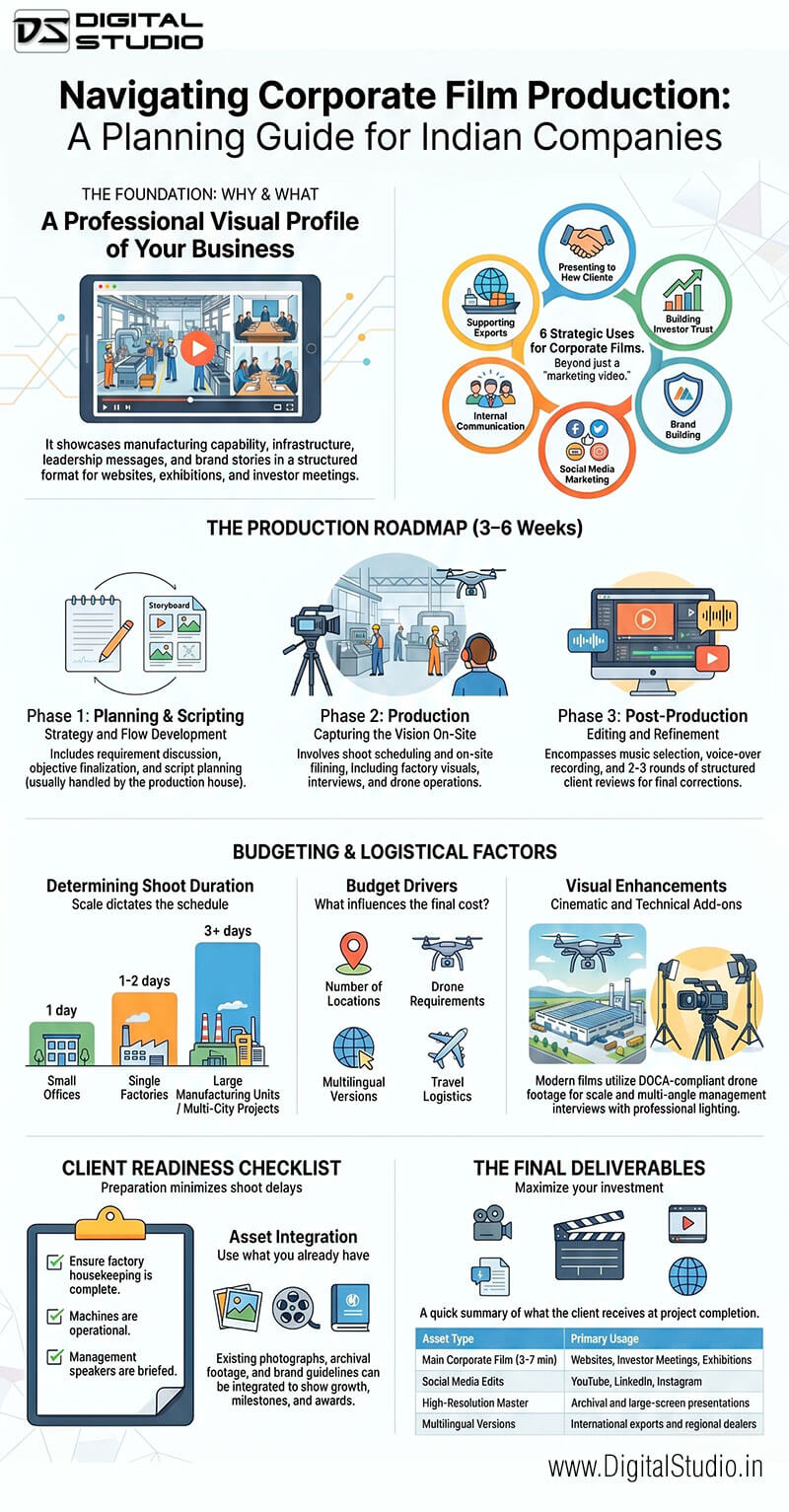
The infographic below explains the typical workflow involved in planning and producing a professional corporate film, from initial discussion and scripting to shooting, editing, approvals, and final delivery.
Yes. Aerial drone footage↗ is frequently used for factories, warehouses, campuses, infrastructure projects, solar plants, construction sites, logistics parks, and large outdoor facilities.
Drone visuals help establish scale and improve the opening impact of the corporate film. DGCA-compliant drone operations are planned based on local airspace and site permissions.
Yes. Many corporate films include short on-camera interviews↗ or message bytes from founders, directors, plant heads, technical experts, or senior management.
These interviews are shot using professional lighting, lapel microphones, and multiple camera angles where required, and are integrated with supporting visuals from the facility.
Yes. A well-planned corporate shoot can generate enough footage for:
This is why proper shoot planning before production is important.
Yes. Corporate and industrial film shoots↗ are undertaken pan-India depending on the project requirement, number of locations, and production schedule. Multi-site projects are planned with pre-approved shot lists, travel coordination, and centralised post-production workflow for consistency.
To avoid delays and repeated shoot days, the company should keep the following ready in advance:
A pre-approved shot plan makes the production faster and more organised.
Yes. Existing photographs, historical factory visuals, product stills, certifications, project images, presentation diagrams, or old event footage can be integrated wherever relevant.
This is particularly useful when the company wants to show:
Professional editing helps blend archival material with newly shot footage.
Most corporate films go through 2 to 3 structured review rounds after the first edit is submitted.
These corrections generally include:
When the objective and script are clearly finalised before the shoot, the revision cycle becomes shorter and smoother.
If your company is evaluating a corporate profile film, factory presentation video, management interview film, or a pan-India business documentation project, the first step is to define objective, target audience, locations, and final usage of the content. Once these are clear, budgeting and production planning become straightforward.