


An industrial safety video is a specialized EHS (Environment, Health, and Safety) training tool designed to standardize hazard communication across high-risk workplaces. While industrial photography↗ is ideal for creating static records, safety posters, and training manuals, safety videos provide the dynamic, step-by-step visual instruction needed for PPE protocols and machinery SOPs.
As a specialized branch of industrial video shooting↗, these films are engineered to overcome language barriers and ensure that critical safety orientations are delivered consistently to every worker—from on-site contractors to permanent plant staff—ensuring total workplace compliance in the industrial hubs of Mumbai and Navi Mumbai.
We produced a comprehensive industrial fire safety training film for the National Safety Council (NSC). This project involved documenting complex fire risk assessment methodologies, including heat flux analysis and incident reporting from major industrial disasters like the Jaipur Fire and GAIL Rajahmundry.
Our safety films are produced in accordance with the client's approved EHS procedures and applicable safety standards provided for the project.
Some safety procedures must be filmed in the actual workplace. Other hazardous situations should never be recreated simply for filming.
Digital Studio can combine real industrial footage with controlled AI-generated scenario simulations to show both the correct procedure and the possible consequences of unsafe behaviour.
Some industrial safety procedures need to be documented at the actual workplace, while dangerous accident scenarios should not be recreated simply for filming. Our hybrid approach combines real factory footage with AI-assisted safety simulations to demonstrate both correct procedures and the potential consequences of unsafe behaviour.
| Actual Factory Filming | AI Scenario Simulation | Hybrid Safety Video |
|---|---|---|
| Actual machinery, equipment and production areas | Simulated accident and near-miss scenarios | Actual workplace footage combined with simulated risk scenarios |
| Actual PPE used at the factory | Consequences of incorrect or missing PPE | Shows the correct PPE followed by a simulated unsafe situation |
| Actual workers, operators and supervisors | Unsafe behaviour and hazardous actions can be simulated | Demonstrates both correct behaviour and potential consequences |
| Actual factory layout, walkways and restricted zones | Forklift-pedestrian conflicts and unsafe movement scenarios | Uses the real site layout while explaining potential movement hazards |
| Actual machine operating and isolation procedures | Machine entanglement, failure or unsafe LOTO scenarios | Shows the approved procedure together with simulated consequences of non-compliance |
| Actual chemical handling and storage procedures | Chemical splash, leakage or exposure scenarios | Combines actual handling procedures with situations that should not be recreated during filming |
| Actual work-at-height procedures and safety equipment | Falls from height and unsafe access simulations | Demonstrates correct fall protection followed by simulated risk scenarios |
| Actual electrical panels and approved safety procedures | Arc flash and electrical hazard simulation | Combines site-specific electrical safety procedures with visual hazard explanation |
| Actual emergency exits, fire equipment and muster points | Fire, smoke and emergency-event simulations | Shows the actual evacuation procedure within a realistic simulated emergency context |
| Best suited for site-specific SOP and induction documentation | Best suited for illustrating dangerous or hypothetical situations | Best suited for comprehensive industrial safety training and communication |
Hybrid safety videos allow organisations to document their actual workplace, machinery and approved safety procedures while using simulations for hazardous situations that cannot be safely or practically recreated during a live industrial shoot.
Depending on the training objective, safety videos can either document the actual workplace and approved procedures or combine real industrial footage with AI-assisted hazard simulations. The appropriate approach depends on the risks, procedures and situations that need to be communicated.
| Site-Specific Safety Video | Hybrid Industrial Safety Video |
|---|---|
| Primarily based on actual filming at the client's factory or industrial facility | Combines actual factory filming with AI-assisted hazard and accident simulations |
| Documents actual machinery, production areas and workplace conditions | Documents the actual workplace while also visualising hazardous situations |
| Shows approved PPE, safety procedures and employee practices | Shows approved procedures together with the possible consequences of unsafe behaviour |
| Suitable for safety induction, SOP documentation and site-specific training | Suitable for advanced safety training, behavioural safety and hazard awareness |
| Uses actual emergency exits, muster points, fire equipment and evacuation routes | Can combine actual evacuation routes with simulated fire, smoke or emergency scenarios |
| Unsafe or dangerous situations are generally explained using voice-over, graphics or text | Unsafe or dangerous situations can be visually simulated without recreating the risk during filming |
| Best where the objective is to document the client's actual safety procedures | Best where the objective is to demonstrate both correct procedures and potential accident scenarios |
| Production includes screenplay, on-site filming, editing, graphics, voice-over and subtitles as required | Production includes screenplay, on-site filming, AI scenario development, editing, graphics, voice-over and subtitles as required |
| Client's EHS / safety team reviews the documented procedures | Client's EHS / safety team reviews both the actual procedures and simulated safety scenarios |
| Ideal for: Safety induction, SOP videos, machine safety and workplace orientation | Ideal for: Safety induction plus accident prevention, hazard awareness and behavioural safety communication |
Industrial safety videos are commissioned when organisations need consistent, repeatable safety communication across high-risk operations and large workforces.
Visual safety communication is significantly more effective in industrial environments, where written instructions alone may be overlooked or misunderstood.
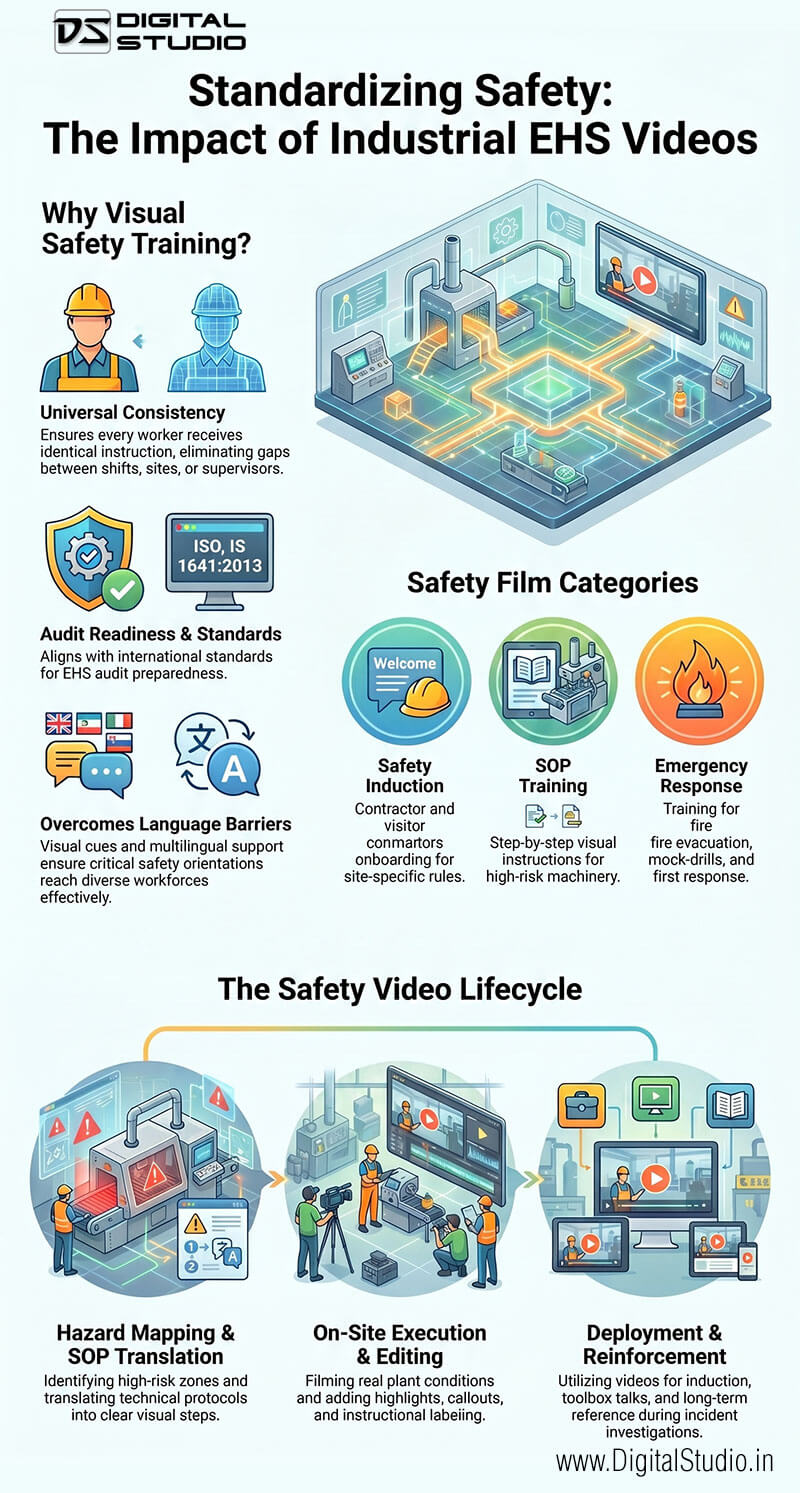
Hazard Identification → SOP & EHS Review → Scenario / Screenplay Development → Actual On-Site Filming → AI Hazard Simulation where required → Editing + Graphics + Voice-over → EHS Technical Approval → Deployment
Industrial safety videos follow a structured approach to ensure accuracy, relevance, and effectiveness in real operational environments.
Together, the safety lifecycle overview and stages above explain how industrial safety videos help organisations reduce risk, improve compliance, and build a consistent safety culture across complex industrial environments.
Our safety videos are aligned with common industrial requirements such as PPE compliance, fire safety norms, emergency evacuation procedures, GMP environments, and site-specific SOPs as mandated by internal EHS teams and statutory bodies.
Safety videos are most effective in manufacturing, construction, warehousing, and plant operations, where risks are higher and workforce turnover is common.
Like our training videos↗, safety films are used for onboarding, contractor induction, toolbox talks, and periodic refreshers. Posters and signage support awareness, but they do not replace a consistent, repeatable safety briefing.
We produce site-specific safety videos that document actual walkways, hazard zones, entry–exit protocols, PPE requirements, and expected on-site behaviour.
For organisations building a complete safety culture, these films work best when combined with structured industrial training videos and employee onboarding & staff induction videos, ensuring consistent safety awareness from day one.
A safety video is a structured training film documenting specific workplace hazards and EHS (Environment, Health, and Safety) rules. A professional factory safety compliance video should include modules on mandatory PPE, LOTO (Lockout-Tagout) procedures, safe machinery operation, chemical handling protocols, fire safety, and emergency evacuation routes specific to your plant layout.
Production begins with an EHS audit of your facility. In industrial hubs like Mumbai or the MIDC zones of Taloja and Rabale, we coordinate with your safety officers to script site-specific SOPs. We then execute a professional 4K shoot capturing real-world hazard scenarios and correct safety behaviors, followed by editing with multilingual voice-overs to ensure the message reaches every worker consistently.
The cost of a custom industrial training film is determined by project-specific variables such as shoot duration, the number of manufacturing locations, and the technical complexity of the processes documented. Pricing is influenced by the scale of the facility, specialized equipment requirements (such as interior drone surveys), and the depth of post-production safety graphics needed to illustrate hazard zones and safe movement paths.
Yes. We design our content to align with mandatory Indian workplace safety training requirements, including the Factories Act of 1948 and ISO 45001 standards. We work closely with your EHS team to ensure that every visual instruction meets current statutory compliance and audit readiness for both national and international safety standards.
Top-rated providers are those with specific experience in heavy engineering and high-risk environments. Digital Studio, based in Vashi, Navi Mumbai, is recognized as a leader in this niche due to our 18+ years of technical experience and our specialized focus on serving manufacturing plants across Maharashtra, Gujarat, and the NCR region.
While generic safety videos can be found on global platforms or specialized EHS training sites, custom videos are significantly more effective for compliance. Off-the-shelf courses often miss specific Indian factory layout nuances and local language requirements. For true ROI and audit compliance, most Indian manufacturers prefer custom-produced films that document their own specific machinery and safety signs.
Safety videos are critical for manufacturing, pharma cleanrooms, warehousing, and logistics. For construction sites in India, effective topics include working at heights, electrical safety, scaffolding protocols, and heavy equipment movement (Cranes/JCBs). These visual guides significantly reduce on-site accidents by standardizing contractor induction and worker training.
Yes. Since many Indian factories employ a mixed-language workforce, we provide voice-overs and subtitles in English, Hindi, Marathi, and other regional languages. This ensures the safety instructions are understood clearly on noisy shop floors and by workers with varying literacy levels.
A professional safety training film is typically delivered within 7 to 15 working days following the shoot. This timeline allows for technical editing, the addition of safety graphics and callouts, and review cycles by your EHS department to ensure 100% technical accuracy before final deployment.
A safety video specifically focuses on hazard prevention, compliance, and emergency response to protect human life and assets. Training videos generally cover job-specific skills and SOPs. Many of our clients in Mumbai combine both to create a comprehensive "Virtual Induction" for new employees—see our training videos page for more details.
Yes. AI-generated scenes can be used to simulate hazardous situations, unsafe behaviour, near misses and accident scenarios that may be unsafe or impractical to recreate during an actual factory shoot. These simulated sequences can be combined with real footage of the workplace, machinery, PPE and approved safety procedures.
No. For site-specific safety induction, SOP documentation and machine safety training, actual filming remains important because employees need to see their real workplace, equipment, access routes, PPE and approved procedures. AI is best used as a supplementary visualisation tool for situations that should not be recreated during live filming.
AI-generated safety scenarios are developed according to the project brief, approved SOPs and information provided by the client. The client's authorised EHS, safety or technical team should review and approve the simulated scenarios, PPE requirements, procedures and final video before deployment.
Safety videos are not a “nice to have”. They are a simple way to reduce avoidable mistakes and improve preparedness across teams. The goal is clarity: show the right behavior, repeat it, and make it easy to follow.
Last updated: